
Printing orders yourself can make sense when volumes are manageable and your equipment suits the work. But as a stationery business grows, production can start to take time away from design, marketing and customer service. The decision to outsource is not simply about being busy: it is about whether in-house production remains the right use of your time, equipment and budget.
This guide sets out the signs to look for, what to weigh up and how a trade printing partner can fit into your business without taking your brand or customer relationships out of your hands.
Signs your production process may be holding you back
Printing and finishing are taking time from other work
Keep track of how much time you spend preparing files, printing, trimming, checking and packing orders. Include time spent reprinting work or correcting production issues. If these tasks regularly push design work, marketing or customer enquiries into evenings and weekends, compare the cost of that time with the cost of outsourcing.
There is no universal point at which a business should outsource. The useful question is whether production is taking time away from work that would help the business more.
Your equipment limits the products you can offer
Some designs call for sizes, shapes or production methods that may not be practical with the equipment you already own. Distinctive formats such as arches, waves and scallops, for example, can require suitable cutting capabilities. Before investing in equipment, consider how often you would use it, the cost of setup and maintenance, and whether a trade printer can produce the work instead.
Outsourcing can also make it easier to explore a broader range of papers, boards and coordinated stationery. Check the partner’s actual specifications and available options rather than assuming every stock, size or finish will be suitable.
Results are difficult to repeat consistently
Small differences in colour, trimming or finishing can become more noticeable when an order includes several coordinated items. If your current process makes it difficult to reproduce the same result from one batch to the next, work out where the variation is coming from before deciding what to change.
A trade printer may be able to offer a more repeatable production process, but consistency still depends on factors such as the supplied artwork, materials and production specifications. Ask how orders are checked and what information they need from you.
What to weigh up before outsourcing
The full cost, not just the print price
Compare the cost of outsourcing with the full cost of producing an order in-house. Alongside paper and ink, account for equipment, maintenance, test prints, spoilage, packaging and your own production time. Then consider the trade price, delivery and any other charges involved in ordering from a supplier.
Outsourcing may not be the cheapest option for every job. It can still make commercial sense if it saves substantial time, avoids an equipment purchase or lets you offer work that would otherwise be impractical.
How much control you need
When you outsource, you still own the design and the customer relationship, but you rely on a supplier to make the physical product. Find out how artwork is submitted, what checks are carried out and how questions or problems are handled. Where available, reviewing a sample or test print can help you assess paper, colour and finish before offering a product to customers.
Build the supplier’s production and delivery timings into the schedule you give your customer. Do not assume that a trade partner’s turnaround will match your in-house process.
Whether your orders are ready to hand over
Before placing an order, make sure your artwork and product details are clear and consistent. That might include the finished size, quantity, paper choice, print requirements and any finishing or shape requirements. Confirm the supplier’s file guidance and proofing process; requirements vary between printers.
A clear handover reduces the risk of avoidable questions, errors or delays. It also makes it easier to repeat successful orders.
When a trade printing partner may be a good fit
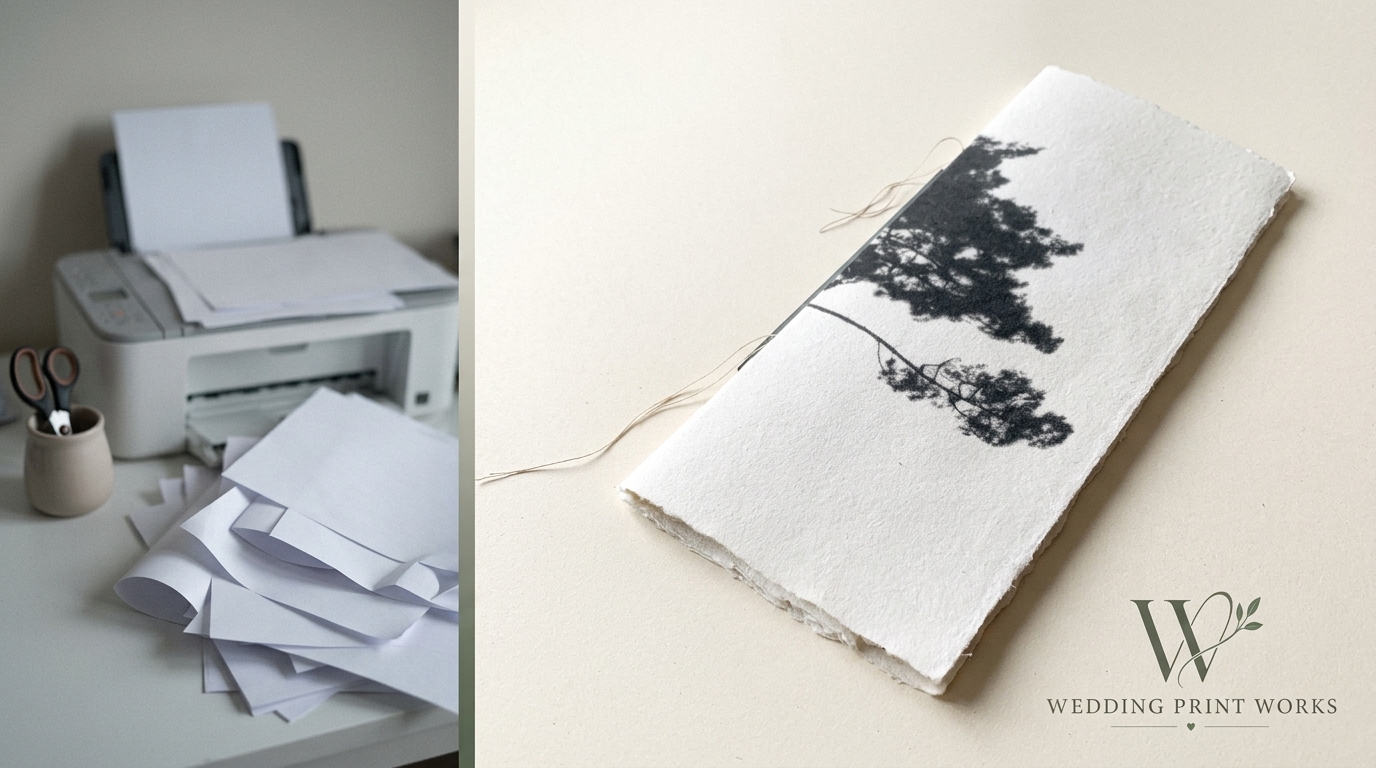
Outsourcing is worth exploring when production regularly competes with other priorities, when customers are asking for products your current setup cannot produce, or when buying and maintaining additional equipment does not make sense for your order volumes.
You do not have to outsource everything. Some designers keep short runs or prototypes in-house and send larger, more complex or coordinated orders to a trade printer. A hybrid approach can help you retain flexibility while reducing the production work that takes the most time.
Use outsourcing to broaden your range thoughtfully
A production partner can help you offer more than invitations, including coordinated save-the-dates, information cards, menus, place cards and other wedding stationery. Before adding products to your range, check that the available sizes, shapes and materials suit your designs and that the costs work for your pricing.
Start with a small number of products, learn how the ordering process works and refine your artwork handover before expanding further. This is more manageable than adding a large range before you understand the production requirements.
Keep your brand and customer relationship
White-label wedding stationery printing is intended to support your business behind the scenes: you retain your designs, brand and relationship with the customer, while a production partner makes the printed items. If white-label handling matters to you, confirm how the supplier manages packaging, paperwork and customer information before placing an order.
Questions to ask a potential trade printer
- Which papers, boards, sizes and shapes can you produce?
- What artwork specifications and file formats do you require?
- How do proofs, corrections and approval work?
- How are colour and cutting checked during production?
- What are the costs, delivery arrangements and expected production timings for the products I need?
- Can orders be supplied white-label, and how are they packaged?
Frequently asked questions
When should a stationery designer outsource printing?
Consider it when in-house production regularly takes time away from design and customer work, your equipment limits the products you can offer, or you need a production process that better suits your order volume. Compare the full costs and practicalities before deciding.
Will outsourcing mean losing control of my brand?
Not necessarily. With a white-label arrangement, the designer retains their brand and customer relationship while the printer handles production. Confirm the supplier’s specific processes for packaging, paperwork and customer information.
Should I outsource every order?
No. The right approach depends on your products, volumes, equipment and available time. You might keep some work in-house and outsource orders that are larger, more complex or less practical to produce yourself.
Wedding Print Works is being developed as a trade production partner for stationery designers and businesses. If you are considering trade wedding stationery printing, compare the products, specifications and processes available with the needs of your own range before choosing a supplier.