Tag: trade wedding invitation printing

  • White‑Label Wedding Stationery Printing: How It Works and Why It Matters for Designers

    White‑Label Wedding Stationery Printing: How It Works and Why It Matters for Designers

    White-label wedding stationery printing allows you to outsource physical production while keeping your own brand and client relationships. You supply the designs and specifications; a print partner produces the finished items for you to sell under your business name.

    For designers and small stationery businesses, this can make it easier to offer coordinated collections without buying production equipment or taking every job through your own workspace. The key is choosing a partner whose process, materials and communication suit the way you work.

    What does white-label wedding stationery printing mean?

    In a white-label arrangement, a third-party printer makes products that are sold under your brand rather than the printer’s. Depending on the agreement, the printer may produce the stationery for you to check, pack and send, or the products may be prepared for another agreed fulfilment arrangement.

    White-label does not automatically settle every detail. Before placing work, clarify whether the printer’s name will appear on the products, packaging, paperwork or delivery information, and who will handle packing, dispatch and any client queries.

    Why use a trade print partner?

    Outsourcing production can free up time for design, marketing and customer service. It may also let you offer products or quantities that would be difficult to produce in-house, without investing in specialist equipment or managing every production step yourself.

    A production partner can help turn approved artwork into printed and finished stationery. Your role remains central: you shape the collection, advise your client, approve the proof and manage the customer relationship. The printer’s role is to manufacture to the agreed specification.

    When comparing suppliers, look beyond the word “white-label”. Ask how they handle artwork, proofs, paper choices, finishing, quality checks, reprints and delivery. Clear answers help you set realistic expectations with your own customers.

    How white-label printing works
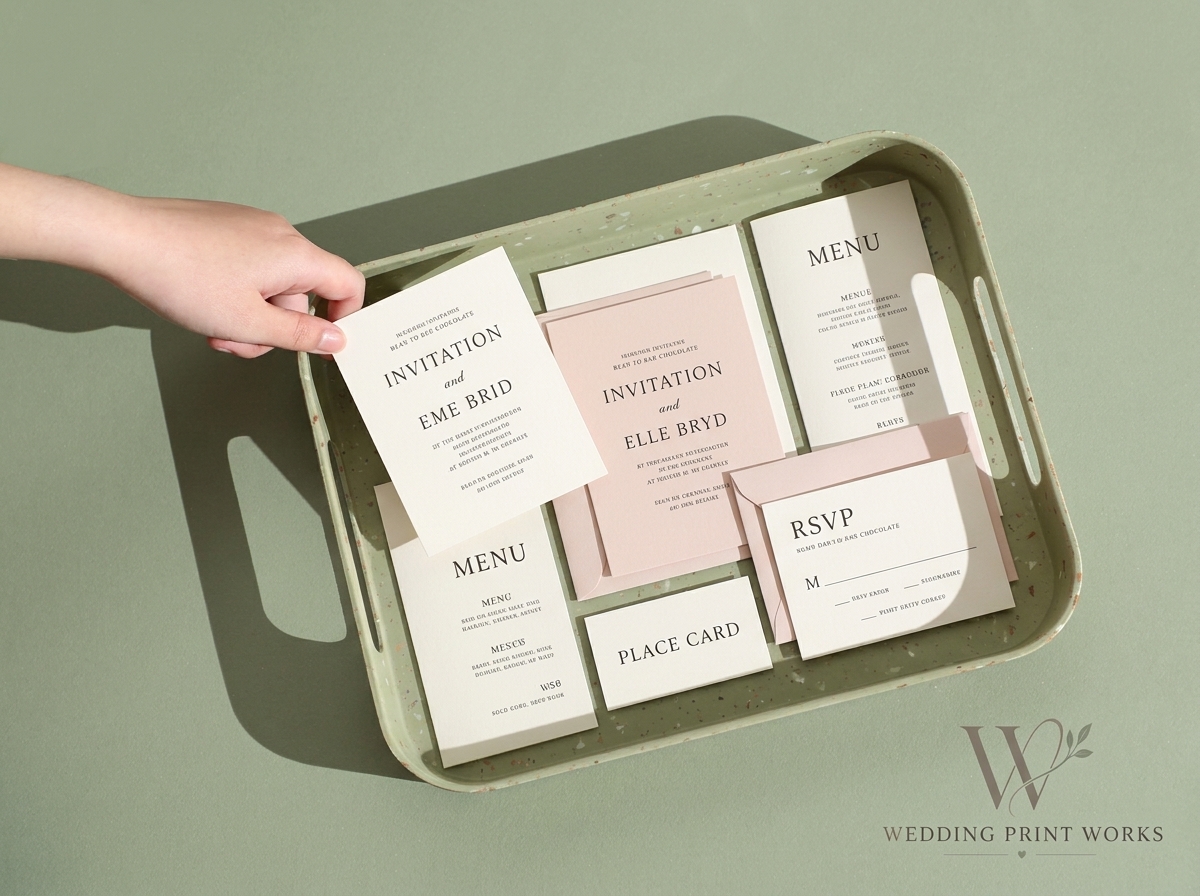
    Wedding stationery being prepared for print production

    1. Agree the specification

    Start by confirming the finished size and shape, paper or board, print requirements, quantity and any finishing details. Include how the pieces relate to one another if you are ordering a suite. A clear specification reduces avoidable queries and gives both you and your supplier a shared reference point.

    2. Prepare and approve artwork

    Supply files in the format and layout requested by the printer. Check spelling, names, dates, alignment and any details that matter to the design before approval. Ask how proofs are supplied and what they show: a digital proof can help check layout and content, but it may not represent the exact colour or feel of the final stock.

    3. Production and quality checks

    Once the artwork and specification are approved, the printer produces the order and checks it against the agreed requirements. Ask what checks are included and how any issue is handled. Colour and appearance can be affected by the artwork, printing process and chosen stock, so discuss expectations before production rather than relying on an on-screen preview alone.

    4. Packing and delivery

    Agree in advance where the finished stationery will be sent and how it will be presented. If you want a fully white-label experience, confirm whether supplier branding is excluded from the products and any accompanying packaging or paperwork.

    Building a coordinated stationery range
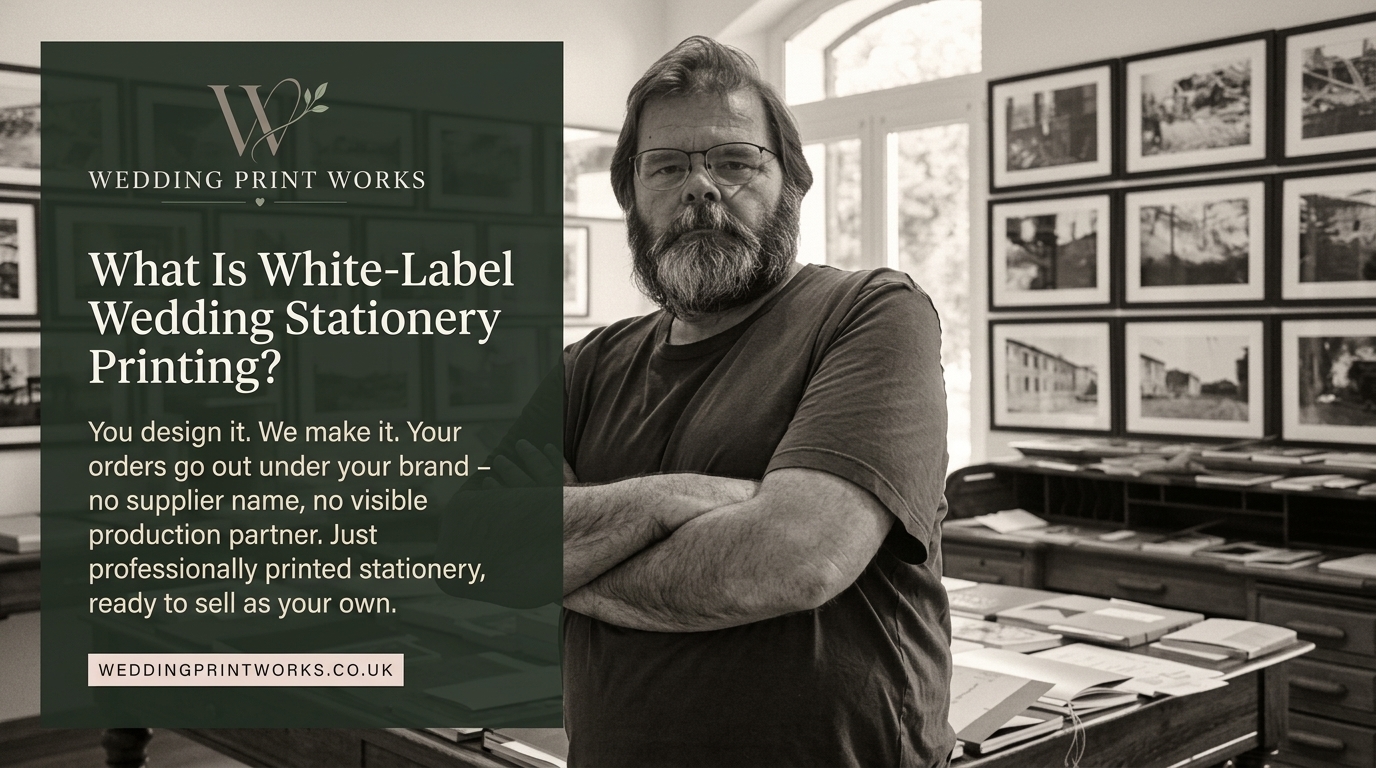
    Coordinated wedding stationery pieces arranged as a collection

    A production partner can help you develop a broader offer around a design. Depending on the products and specifications available, a collection might include save-the-dates, invitations, information cards, menus, place cards, table stationery and other printed wedding items.

    Choose materials to suit the design

    Paper and board affect the look, weight and feel of a finished piece. When selecting stock, consider how it supports the artwork, how it will be used and whether it needs to work across several items in the suite. Ask your printer which options are available and whether the chosen stock is suitable for the size, shape and production method.

    Consider shapes and finishing early

    Distinctive shapes, such as arches, waves and scallops, can help a collection feel individual. They also affect artwork preparation and production, so discuss the shape and finished dimensions with your printer before finalising the design. If you are considering specialist finishing, check what is available, how it affects the specification and whether it can be applied consistently across the pieces in your order.

    Keeping your brand and customer relationships

    In a white-label arrangement, you remain the designer and the customer-facing business. Your client buys from you, and you decide how the collection is presented and priced. The production partner works behind the scenes according to the agreed process.

    It is worth confirming practical details in writing: who communicates about artwork queries, who approves proofs, how changes are handled and who contacts the client if a delivery issue arises. A dependable workflow is as important to your brand as the finished print.

    Frequently asked questions

    What is white-label wedding stationery printing?

    It is a production arrangement in which a printer manufactures stationery designed or supplied by your business for you to sell under your own brand. The exact arrangements for branding, packing and delivery should be agreed with the supplier.

    Will my clients know who printed the stationery?

    That depends on the arrangement. Confirm whether the printer’s branding will appear on the stationery, packaging, paperwork or delivery information. White-label production should be discussed in practical terms rather than assumed to cover every part of fulfilment.

    Can I offer a full range of wedding stationery?

    A trade print partner may help you extend your range across items such as invitations, information cards, menus and place cards. Check the available products, materials, sizes, shapes and finishes before promising a particular option to a client.

    How can I check the quality before offering a product?

    Ask about the proofing process and request samples where available. A proof can help you check content and layout, while a physical sample gives a better sense of the stock and finish. Confirm how the printer handles production checks and any problems with an order.

    Wedding Print Works supports designers with trade wedding stationery printing, helping businesses keep their focus on design and customers while their stationery is produced to an agreed specification. Explore the options for designers.
  • How to Turn Your Etsy Wedding Invitation Templates into Printed Products (Without Buying a Printer)

    How to Turn Your Etsy Wedding Invitation Templates into Printed Products (Without Buying a Printer)

    If you sell wedding invitation templates on Etsy, adding printed products can open up a new way to serve customers. You can keep your designs, brand and customer relationships without buying printing equipment or managing every production step yourself.

    The key is to prepare artwork for physical production, decide how orders will be handled, and work with a production partner whose processes suit your products. Here’s how to approach the move from digital downloads to printed stationery.

    Plan how printed orders will work

    Start by deciding what you will sell and how each order will be produced. Some designers offer fixed designs, while others personalise names, dates or wording after a customer orders. In either case, check that the artwork and order details are complete before sending a file to print.

    Consider the customer journey too: what information you need at checkout, how personalisation will be confirmed, who will package and dispatch the stationery, and how you will handle reprints or changes. Agreeing these details with your production partner helps avoid confusion once orders start coming in.

    Check whether your artwork is ready for print

    A design that looks good on screen may need adjustments before it can be printed. Check the finished size, image quality, fonts, colour setup and any production requirements for the chosen paper or shape. Ask your printer for its file specifications before preparing a template; requirements can vary.

    Use suitable files and image resolution

    A print-ready PDF is often a practical format, but follow the printer’s instructions. Keep vector artwork as vector where possible. For raster images, such as photographs, check that their effective resolution is suitable at the size they will be printed. Around 300 pixels per inch is a common guide for many stationery images, but the right setting can depend on the artwork and production method.

    Make sure fonts are embedded in the PDF or handled in the way your printer requests. If a file contains linked images, confirm they are included in the export. A preflight check can help catch missing fonts, low-resolution images and incorrect page dimensions before production.

    Set the page size, bleed and safe area

    Set the document to the agreed finished size. If colour or artwork runs to the edge, include bleed beyond the trim line so small variations in cutting are less likely to leave an unwanted white edge. The bleed amount is not universal, so use the measurement specified by your printer.

    Keep names, wording, borders and other important details safely inside the trim area. This is especially important for shaped stationery, where the cut line may bring parts of the design closer to an edge than on a standard rectangle. Use a supplied template or confirm the cutting requirements before finalising the layout.

    Prepare colour with the printer’s guidance

    RGB is designed for screens, while printing commonly uses CMYK or another production-specific colour workflow. Converting a file from RGB to CMYK can change some colours, so do not assume a conversion will reproduce an on-screen colour exactly. Ask your printer which colour profile or PDF settings to use, and whether a proof is available for checking the result.

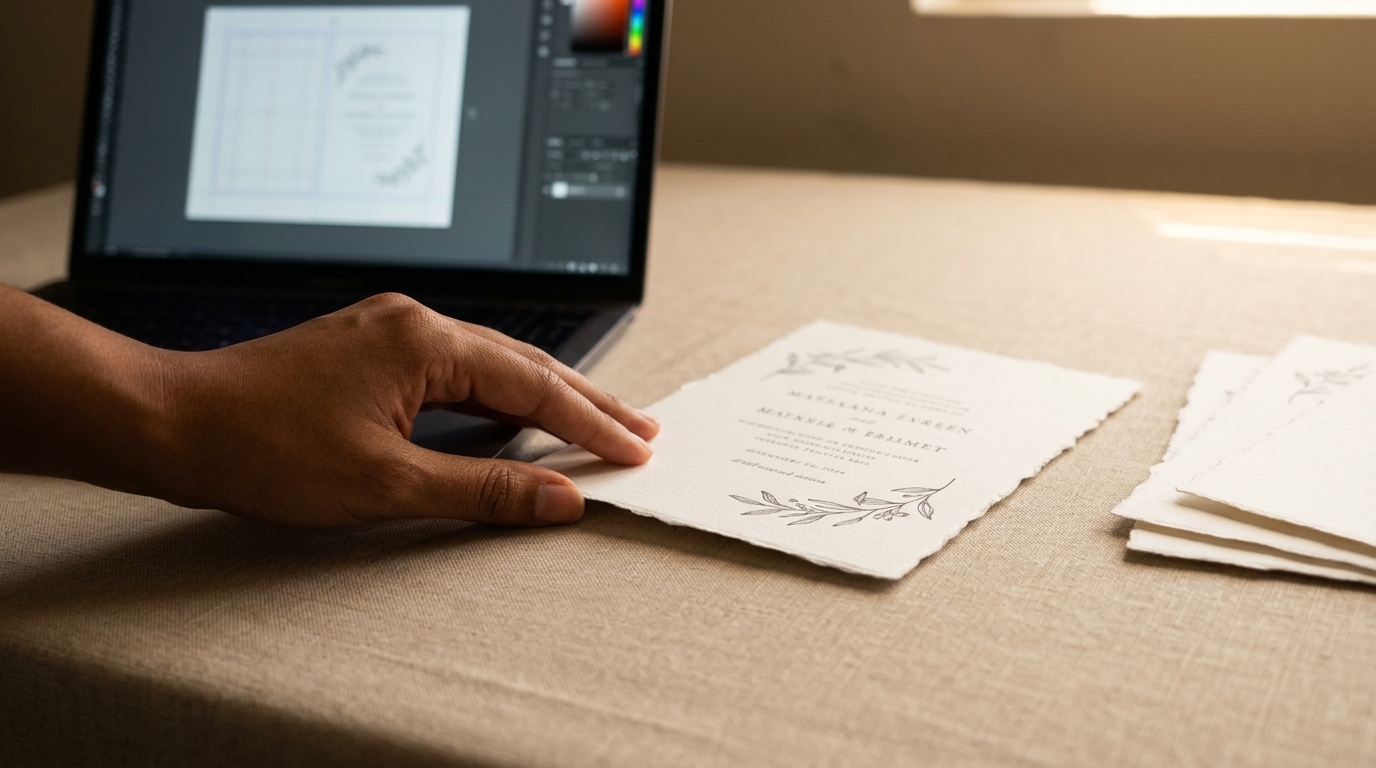
    Wedding stationery artwork prepared for print

    Choose paper and format for the design

    Paper affects how a design looks and feels, as well as how it works as part of a stationery set. Think about the style of the artwork, the amount of text, the intended use and how the invitation will be handled. If you are considering a particular paper or board, ask what is available and request samples where possible before listing it as an option.

    Plan coordinated items together rather than treating the invitation as a standalone product. Save-the-dates, information cards, menus, place cards and table stationery can give customers a coherent set and help you extend a design across more products.

    Shape can also become part of a collection’s identity. Arches, waves and scallops are examples of distinctive formats to explore, provided the artwork is set up to the agreed cutting template and the production requirements are confirmed in advance.

    Find a production partner that fits your business

    A trade printer handles physical production, so you do not need to invest in a printer or take on every finishing task yourself. Look for a partner who can explain file requirements, discuss suitable paper and formats, and help you understand how orders move from approved artwork to finished stationery.

    Before committing a design to a product listing, clarify practical points such as file submission, proofing, packaging, dispatch and how customer details will be managed. If you want to sell under your own brand, ask whether the service supports white-label production and agree how the stationery will be presented to your customer.

    Make outsourcing work commercially

    Outsourcing does not remove the need to price carefully. Include production, packaging, delivery, Etsy fees, personalisation time and the cost of any proofs or samples when working out your margins. Set clear expectations for customers about what they need to provide and when their wording or artwork changes can still be made.

    It can also help you test a small, focused range before expanding. Start with designs that adapt well to several formats, then use customer interest and order patterns to decide which coordinated products to add. A production partner can take on the physical work while you concentrate on design, marketing and customer service.

    Printed wedding stationery in a coordinated collection

    Wedding Print Works provides trade wedding stationery printing for designers and stationery businesses. Designers retain their own brand and customer relationships while outsourcing production across coordinated wedding stationery, with a range of papers, boards, sizes and shapes to consider.

    Frequently asked questions

    Do I need to buy a printer to sell printed invitations on Etsy?

    No. You can outsource production to a trade printer. You will still need a process for collecting customer details, approving artwork and arranging fulfilment, but you do not need to print the stationery yourself.

    What file should I send to a trade printer?

    A print-ready PDF is often suitable, but always follow the printer’s file specifications. Check the finished dimensions, image resolution, fonts, colour settings and bleed before submitting artwork.

    Does every design need 3mm bleed?

    No single bleed amount applies to every job. The required bleed depends on the printer’s production specifications. Ask for the correct measurement and keep important content inside the safe area.

    Should I convert my artwork to CMYK?

    Use the colour settings requested by your printer. CMYK is common in print production, but colour conversion can change the appearance of some colours. Ask about the recommended profile and proofing process rather than assuming an on-screen colour will reproduce exactly.

    Can I offer shaped invitations and matching stationery?

    Distinctive shapes such as arches, waves and scallops can help a collection stand out. Confirm the available formats and cutting requirements with your production partner, then build the artwork to the appropriate template.